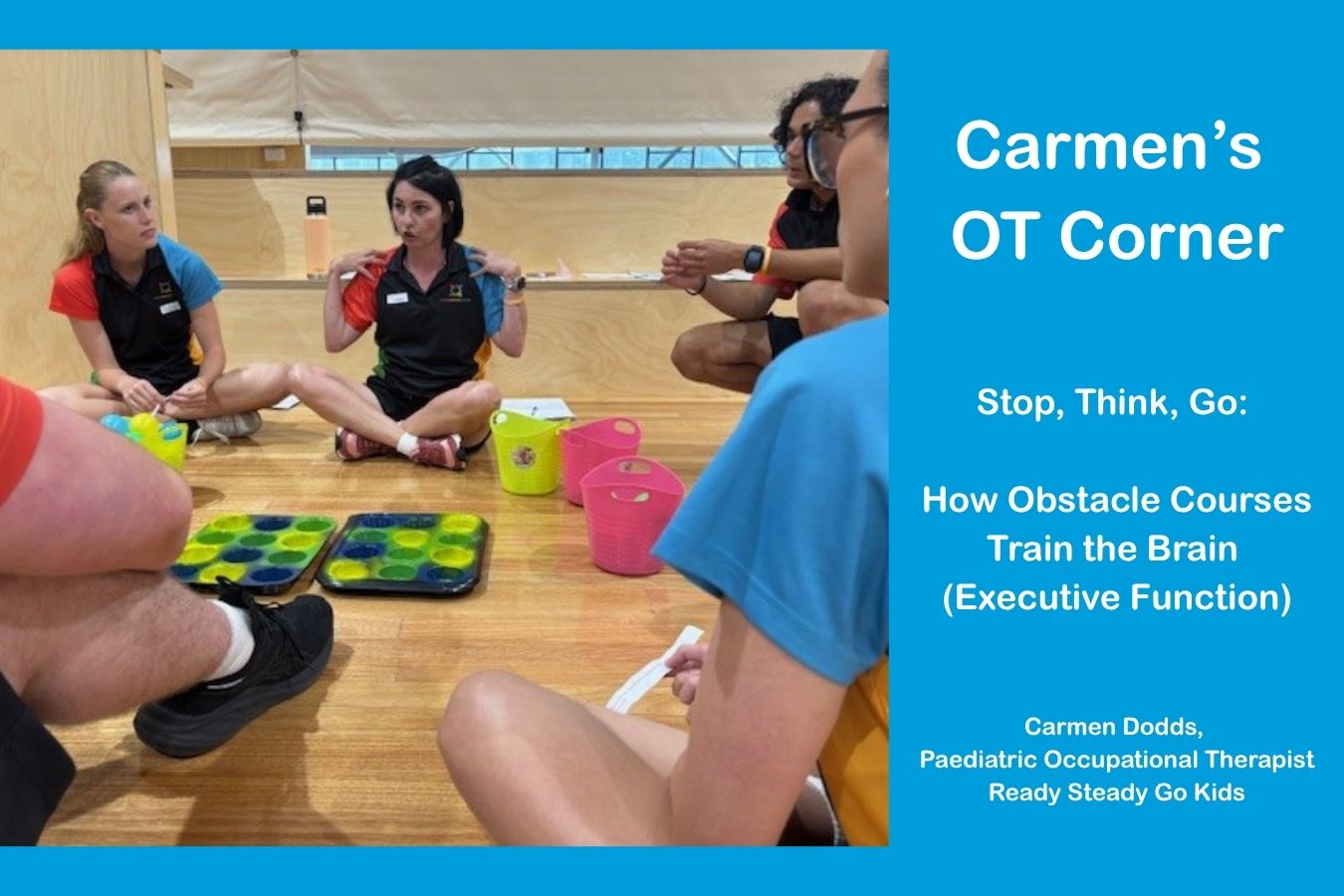
Carmen's Corner: Stop, Think, Go: How Obstacle Courses Train the Brain (Executive Function)
Ever watched your little one barrel towards something they shouldn't touch, completely ignoring your "wait!" or "stop!"? Before you reach for that third coffee, here's some reassuring news: their brain is still building the very skills needed to pause, think, and then act. And here's the exciting part: obstacle courses are one of the best ways to train those skills.
What Is Executive Function (And Why Should Tired Parents Care)?
Executive function is essentially the brain's air traffic control system. It helps children manage their thoughts, actions, and emotions to achieve goals. Three key components make up this system:
- Inhibition – the ability to stop and resist impulses
- Working memory – holding information in mind while using it
- Cognitive flexibility – adapting when plans change
These skills directly impact how well children can follow instructions, sit still during story time, and eventually tackle reading and writing at school. Without them, even simple tasks become overwhelming.
From an Occupational Therapy (OT) point of view, this matters because executive function is needed for everyday tasks and has a huge impact on daily function.
These are the skills that support all the “life stuff” that happens outside the obstacle course, like:
- Getting ready – starting a task, staying with it, and finishing (even when it is not fun)
- Following routines – remembering steps like “shoes, drink bottle, then out the door”
- Self-care – brushing teeth, toileting, washing hands, getting dressed in the right order
- Playing with others – waiting, taking turns, coping when the game changes
- Transitions – stopping one activity and shifting to the next without a full-scale meltdown
How the Ready Steady Go Kids Obstacle Courses Build the "Stop, Think, Go" Brain
When they navigate an obstacle course they learn to:
Stop -Pause and listen to instructions before starting, rather than rushing in.
Think - Plan the order of obstacles—what comes first, second, and third.
Go - Move through the course while remembering the sequence and following the rules.
Adjust - Adapt their plan when something unexpected happens or a challenge feels tricky.
These moments build key executive function skills like planning, working memory, flexible thinking, and self-control - all through being active.
So when children move through an obstacle course, they are not just building on their gross motor skills, they are also strengthening the brain's skills needed for learning and self-regulation.
"When a child approaches a tunnel, then a balance beam, then a hurdle, their brain is working overtime: planning the sequence, remembering what's next, and resisting the urge to skip ahead. These are the exact same skills they'll need to follow a teacher's multi-step instructions in the classroom." explains Carmen
The Real-World Transfer
Executive function skills developed through obstacle course play transfer to:
- Academic performance – following sequences, staying on task
- Social interactions – taking turns, adapting to others
- Daily tasks – getting dressed, packing bags, organising belongings
Children who practise these skills through physical play often demonstrate improved self-regulation and problem-solving in other environments.
How Ready Steady Go Kids Supports Executive Function
At Ready Steady Go Kids, obstacle courses are intentionally designed with executive function in mind. Coaches guide children through sequences that challenge them to stop, think, and then go: building those neural pathways with every session.
"We deliberately vary our obstacle courses each week. This challenges children's cognitive flexibility: they can't just rely on memory. They have to actively listen, process new information, and adapt. It's brain training through movement, and children absolutely love it." adds Carmen
What Parents Can Do at Home
Creating simple obstacle courses at home reinforces these skills:
- Use cushions, chairs, and boxes
- Give verbal instructions before they start
- Change the sequence each time
- Celebrate their problem-solving, not just completion
Ready to See It in Action?
If you want to check out a class and see the benefits for yourself, book a FREE TRIAL. Watch your child's brain light up as they stop, think, and go.