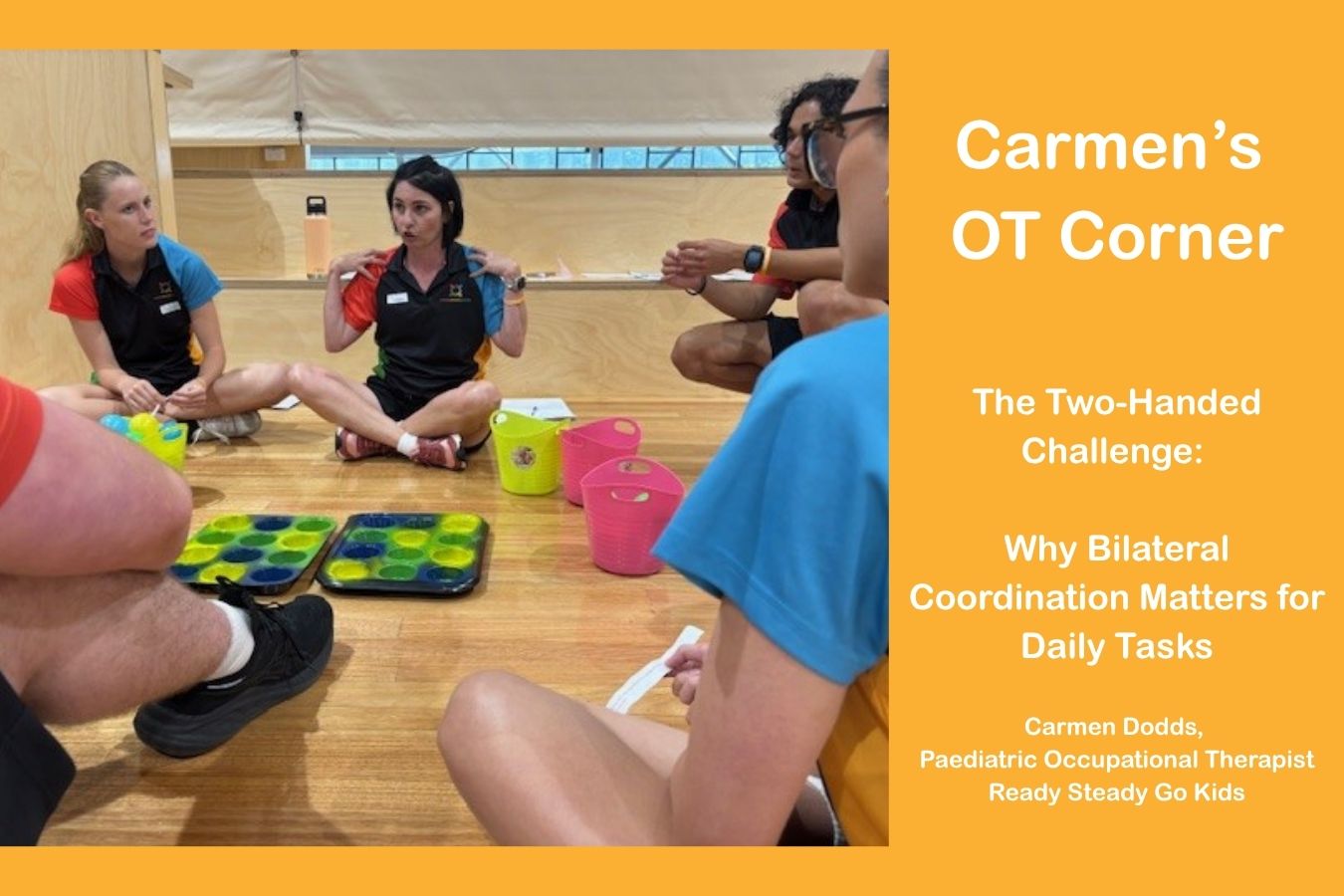
Carmen's Corner: The Two-Handed Challenge: Why Bilateral Coordination Matters for Daily Tasks
Ever watched your little one try to butter toast, only for the bread to slide across the plate like it's auditioning for an escape act? Or perhaps getting dressed turns into a wrestling match with a sock that simply refuses to cooperate?
Before you chalk it up to stubbornness (or the need for more coffee), there might be something else at play: bilateral coordination.
What Exactly Is Bilateral Coordination?
Bilateral coordination is the ability for both sides of the body to work together in a smooth, coordinated way. It's what allows your child to hold a piece of paper steady with one hand while cutting with scissors in the other. Or catch a ball using both hands at once. Or even just clap along to their favourite song.
This skill requires the left and right hemispheres of the brain to communicate effectively: and for young children, that communication pathway is still under construction.
"Bilateral coordination is one of those foundational skills that parents don't always recognise, but it underpins so much of what we ask children to do every day," says Carmen Dodds, Occupational Therapist at Ready Steady Go Kids. "From getting dressed in the morning to sitting down and writing their name, both sides of the body need to work as a team."
Why It Matters More Than You Think
Bilateral coordination isn't just about sport or physical activity: it's woven into almost every daily task your child performs.
Self-care skills:
- Pulling up pants (one hand holds, one hand pulls)
- Brushing teeth (one hand holds the brush, the other steadies the head)
- Tying shoelaces (both hands working in a complex sequence)
Classroom skills:
- Writing (one hand writes, the other stabilises the paper)
- Using scissors (one hand cuts, the other guides the paper)
- Opening a lunchbox (one hand holds, one hand lifts)
Sport and play:
- Catching a ball - both hands move towards the ball together
- Riding a bike - legs push the pedals & hands work together on the handlebars to steer and stabilise the bike
- Climbing playground equipment - arms and legs take turns supporting and moving the body
When bilateral coordination is underdeveloped, these everyday activities can feel frustrating and exhausting for children: and for the parents watching on.
The Three Types of Bilateral Coordination
Not all two-handed tasks are created equal. Occupational therapists typically recognise three patterns:
- Symmetrical movements – Both hands doing the same thing at the same time (catching a ball, pushing a shopping trolley)
- Alternating movements – Hands taking turns in a rhythmic pattern (climbing a ladder, beating a drum)
- Dominant/supporting hand movements – One hand leads while the other assists (writing, cutting, threading beads)
Each type builds on the others, and children develop these skills progressively through play and practice.
Signs Your Child May Need Extra Support
Every child develops at their own pace, but there are a few signs that bilateral coordination could use some extra attention:
- Avoids activities that require two hands
- Switches hands frequently during tasks like drawing or eating
- Struggles with buttons, zips, or shoelaces
- Difficulty catching or throwing a ball
- Becomes frustrated with cutting or craft activities
- Has trouble stabilising paper while writing
If these sound familiar, it doesn't mean anything is "wrong": it simply means targeted practice could make a real difference.
How Sports and Movement Build Bilateral Skills
Here's where it gets exciting for parents: the playground and the sports field are actually brilliant classrooms for bilateral coordination.
"When a child catches a ball, they're not just learning sport: they're training both sides of their brain to communicate," explains Carmen. "Bilateral coordination matters because it supports overall motor confidence and independence. Activities like throwing, catching, balancing, and even crawling through tunnels all strengthen the neural pathways that support bilateral coordination. It's purposeful play with powerful outcomes."
Activities that specifically target bilateral coordination include:
- Ball games – Catching, throwing, bouncing, and rolling all require both hands to work together
- Climbing – Alternating hand-over-hand movements strengthen coordination patterns
- Balance activities – Core stability supports the body's ability to coordinate movements across the midline
- Parachute games – Lifting and shaking a parachute requires symmetrical, synchronised effort
- Obstacle courses – Crawling, jumping, and manoeuvring through obstacles engages the whole body
How Ready Steady Go Kids Supports Bilateral Development
At Ready Steady Go Kids, bilateral coordination isn't a separate "lesson": it's embedded into everything we do. Our multi-sport program is specifically designed to give children exposure to a wide range of movement patterns that build these foundational skills naturally.
Through activities like:
- Catching and throwing drills
- Two-handed bat and racquet sports
- Balance beam challenges
- Team relay games
- Climbing and crawling circuits
...children practise bilateral coordination in a fun, supportive environment where the focus is on participation, not perfection.
Our coaches understand that every child is on their own developmental journey. Whether your little one is a natural catcher or still figuring out which hand does what, our classes meet them where they are.
Simple Activities to Try at Home
Looking for ways to support bilateral coordination between classes? Here are a few parent-approved ideas:
- Rolling and catching a ball – Start seated, facing each other
- Popping bubbles with two hands – Clapping bubbles encourages symmetrical movement
- Threading pasta onto string – One hand holds the string, one threads
- Tearing paper for collage – Both hands work together to grip and tear
- Climbing at the playground – Monkey bars and ladders are bilateral gold
The best part? None of these require special equipment or perfect execution. Just play.
The Bigger Picture
Bilateral coordination might sound technical, but at its core, it's about helping your child navigate their world with greater confidence and independence. When both sides of the body work together smoothly, daily tasks become less frustrating: for everyone involved.
And that means fewer sock battles, smoother mornings, and maybe even a few extra minutes to enjoy that coffee while it's still hot.
Want to see bilateral coordination in action? Our Ready Steady Go Kids classes are designed to build these essential skills through fun, multi-sport activities. If you'd like to check out a class and see the benefits for yourself, book a FREE TRIAL today.