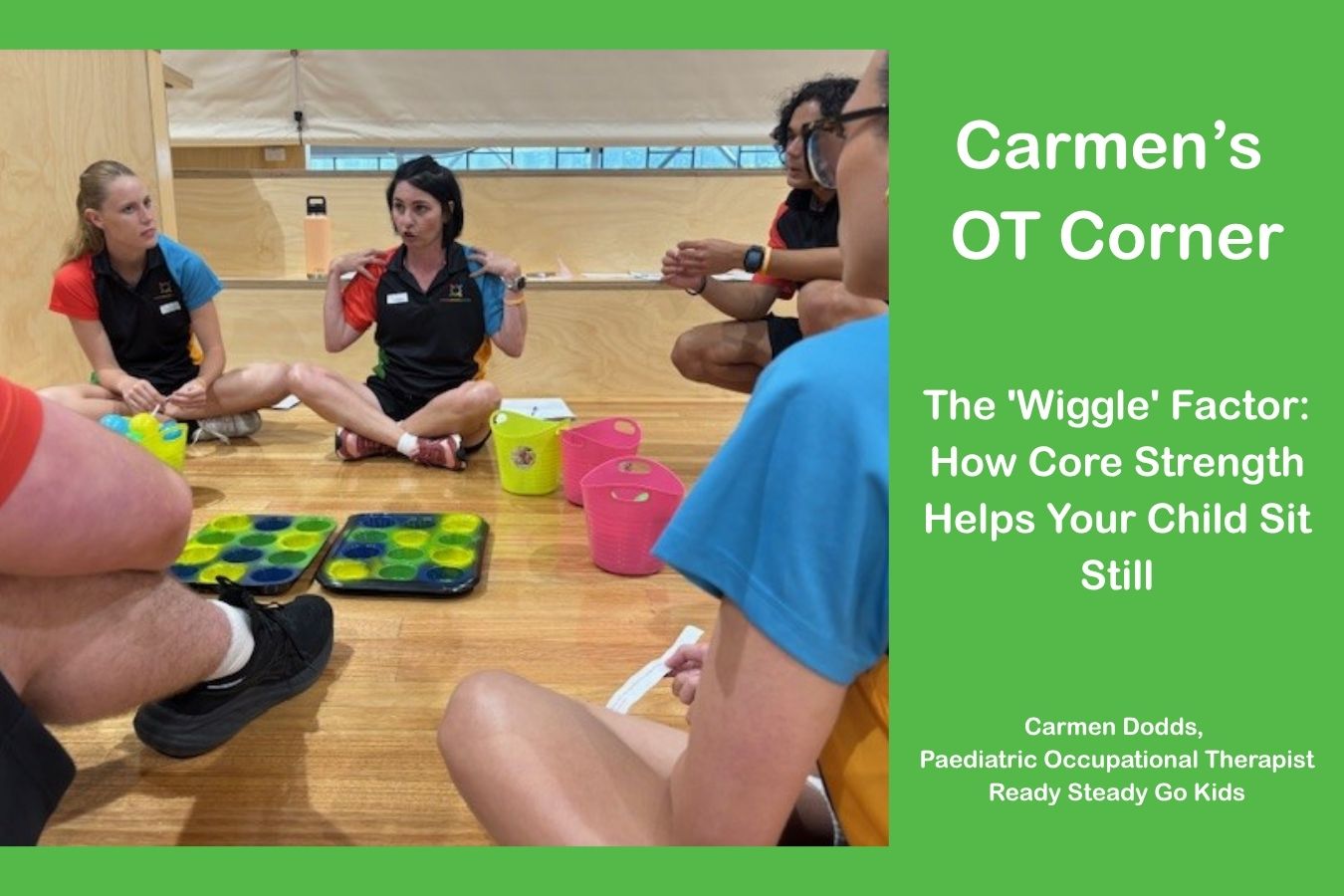
Carmen's Corner: The 'Wiggle' Factor: How Core Strength Helps Your Child Sit Still
The Scene Every Parent Knows
You've asked your child to sit at the table for dinner. Within thirty seconds, they're sliding off the chair, leaning on one elbow, or practically doing yoga poses just to stay vaguely upright. Sound familiar?
Before you reach for that third coffee and wonder where you went wrong, here's some reassuring news: the wiggling isn't defiance. It's often a sign that their little body is working overtime to compensate for developing core muscles.
Welcome to Carmen's Corner, where our in-house Occupational Therapist, Carmen Dodds, breaks down the connection between physical development and everyday skills.
The Dinner Table Struggle (And Why It Is Not Just “Bad Behaviour”)
During meals, it is common for children to:
- Lose focus after a few bites and start scanning the room for “something more interesting”
- Slide off the chair, kneel sideways, or hook one leg under the table like a tiny gymnast
- Struggle to stay seated long enough to finish
- Find holding a fork or spoon hard work, then give up and lose interest in feeding themselves
This pattern is often linked to reduced core and trunk stability. When the trunk has to work harder to keep the body upright, less energy is available for precise hand use and sustained attention. Movement then gets used as a strategy to “find” stability, even when the expectation is sitting still.
What Is the 'Wiggle Factor'?
The 'wiggle factor' refers to the constant movement children display when they're required to sit still. From an Occupational Therapy perspective, this behaviour is frequently linked to core muscle strength: or the lack thereof.
The core muscles include the abdomen, back, pelvis, and hips. These muscle groups provide the postural stability necessary to sit upright without external support.
"When a child's core muscles aren't yet strong enough to hold them steady, sitting still actually becomes harder than moving," explains Carmen Dodds, Occupational Therapist at Ready Steady Go Kids. "Their body naturally seeks out movement because it requires less endurance than maintaining a fixed position."
Why This Matters for Learning
Here's where it gets interesting for parents thinking about school readiness.
When a child must dedicate brain power to staying upright, fewer cognitive resources remain for listening, concentrating, or completing tasks. The child isn't choosing to be distracted: their body is simply prioritising balance over everything else.
This is why children with weaker core strength often:
- Slouch or lean heavily on desks
- Prefer lying down during floor activities
- Fatigue quickly during fine-motor tasks like drawing or writing
- Struggle to maintain attention in structured settings
Signs to Look For
Common indicators of developing core strength include:
- Frequent position changes while seated
- W-sitting (knees bent, feet splayed behind)
- Standing with belly pushed forward
- Difficulty sitting without back support
- Restlessness during quiet activities
These are not behavioural issues. They are physical signals.
How Gross Motor Play Builds Core Strength
The solution isn't asking children to sit still more often. It's giving them more opportunities to move in ways that build those essential muscles.
"Activities like balancing, crawling, climbing, and jumping all engage the core," says Carmen. "The more we build strength through play, the easier it becomes for children to sit comfortably when they need to: like during story time or in the classroom."
How Ready Steady Go Kids Supports Core Development
At Ready Steady Go Kids, our multi-sport classes are specifically designed to develop gross motor skills: including core strength: through fun, age-appropriate activities.
Each session incorporates:
- Balance beam and stepping activities
- Obstacle courses that engage the whole body
- Crawling, climbing, and jumping exercises
- Sport-specific movements that challenge stability
Children build strength without realising they're working hard. To them, it's just play.
And for parents? It's a chance to connect with other mums and dads who also haven't been to the toilet in peace for years. You're not alone.
The Takeaway
The wiggling isn't the problem: it's the clue. Strong core muscles give children the physical foundation they need to sit, focus, and learn with confidence.
If you want to check out a class and see the benefits for yourself, book a FREE TRIAL.