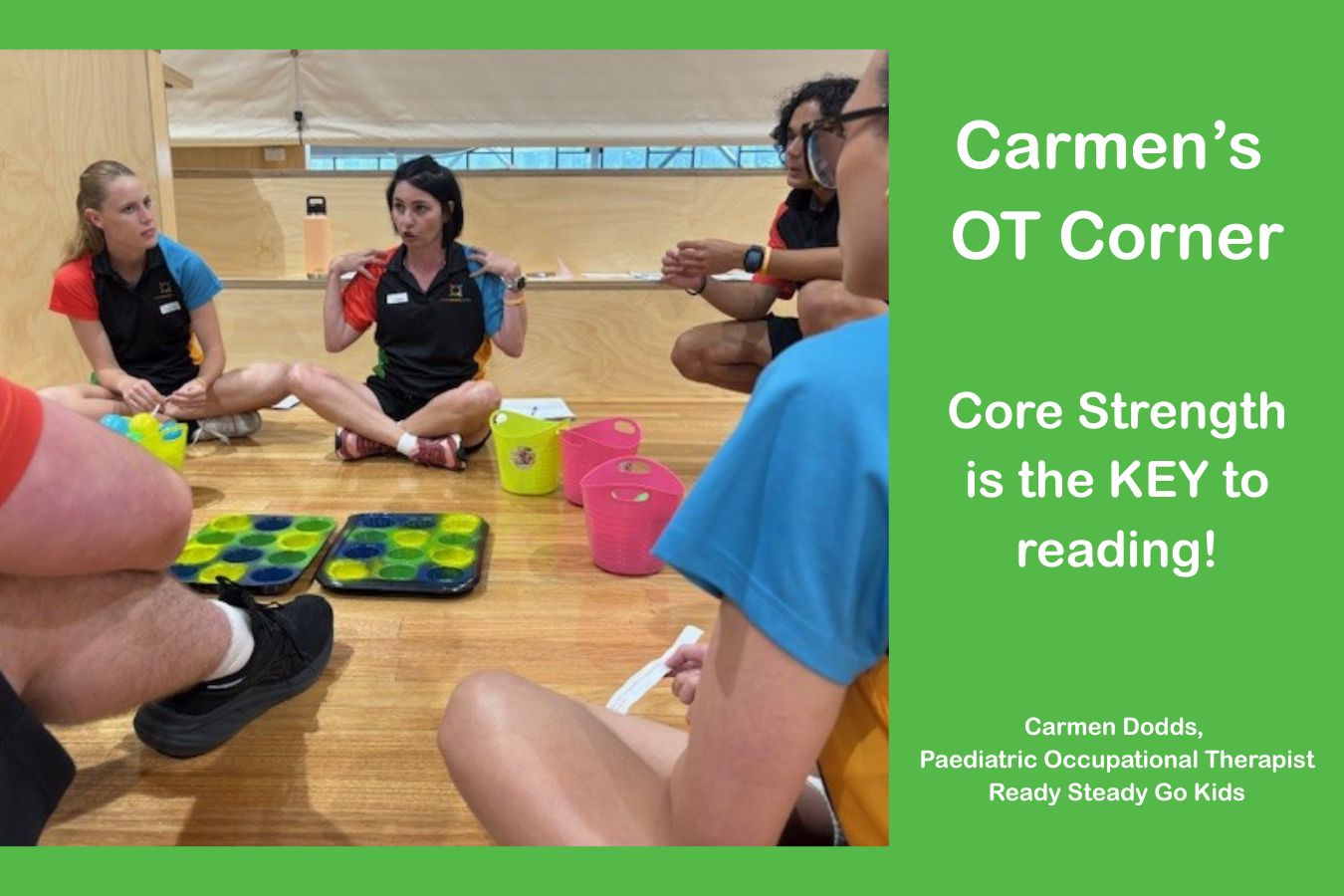
Carmen's Corner - Why Core Strength is the secret to reading
What If the Key to Reading Wasn't in a Book?
Picture this: your little one is finally sitting still (a
miracle, we know) ready to read. But their eyes keep jumping around the page,
they're fidgeting, and frustration is building. Sound familiar?
Here's something that might surprise you: the secret to
smoother reading might actually start with core strength, not flashcards.
Welcome to the first edition of Carmen's Corner, where we
unpack the fascinating connections between physical development and classroom
success. Today, we're solving the "midline mystery."
What on Earth is "Crossing the Midline"?
Imagine an invisible line running from your child's head to
their toes, splitting their body into left and right halves. "Crossing the
midline" is simply the ability to reach one hand, foot, or eye across this
imaginary centre to the other side.
Sounds basic, right? But this seemingly simple movement is
actually a powerhouse skill that connects the left and right hemispheres of the
brain through a structure called the corpus callosum.
"When a child successfully crosses their midline,
both sides of their brain are communicating efficiently. This bilateral
coordination is the neurological foundation for tasks we often take for
granted: like reading words smoothly from left to right across a page." Carmen Dodds, Occupational Therapist, Ready Steady Go Kids
The Core Strength–Reading Connection
So where does core strength fit in?
Core stability provides the stable base needed for arms,
legs, eyes, and hands to move across the body efficiently. In practical terms,
the head and trunk need to be stable to allow the eyes and hands to move across
the midline smoothly.
Midline crossing also requires a lot more effort when
posture is poor. If a child is slumping, propping themselves up on one arm, or
constantly readjusting in their chair, reaching across the body (and tracking
across a page) becomes harder work than it needs to be.
Here is the classroom impact: with a stronger core, kids can
maintain an upright posture for longer. Because less energy is being spent just
“holding themselves upright,” more cognitive energy is available for fine motor
and visual tasks like reading (tracking work from left to right) and writing
across a page.
How Ready Steady Go Kids Supports Midline Development
At Ready Steady Go Kids, our multi-sport classes are
specifically designed to build these foundational gross motor skills: including
core stability, posture, and coordination that support midline crossing.
Through activities like:
- Walking
along balance beams
- Throwing
and catching across the body
- Navigating
obstacle courses
- Kicking
with alternate feet
...children naturally strengthen the neural pathways that
will later help them track words across a page, hold a pencil with control, and
sit comfortably at a desk.
"Parents often ask how sport helps with school
readiness. The answer lies in these hidden connections. Every time a child
braces their tummy, holds their posture, and reaches across their body to catch
a ball, they are building the same coordination their brain needs for reading
and writing." Carmen Dodds, Occupational Therapist, Ready Steady Go Kids
The Takeaway for Parents
You don't need to choose between active play and academic
preparation. Physical development and cognitive development are deeply
intertwined: especially in those early years.
So next time your little one is wobbling along a beam or
reaching across to grab a ball, know that they're not just playing. They're
building the very foundation their brain needs to become a confident reader.
If you want to check out a class and see the benefits for
yourself, book a FREE TRIAL.
Carmen's Corner is a monthly series exploring the
connection between gross motor skills and classroom success, brought to you by
Ready Steady Go Kids.