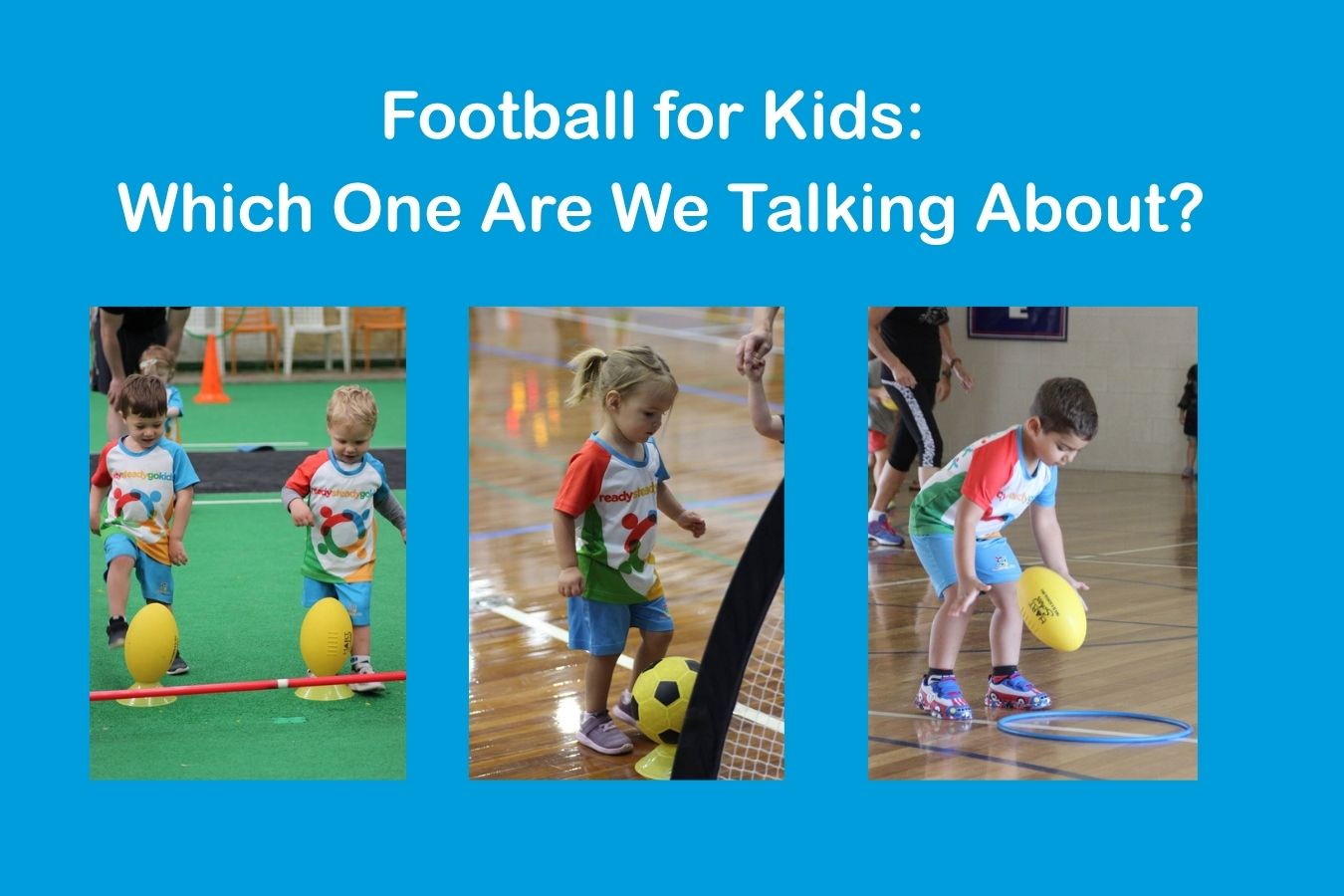
Football for Kids: Which One Are We Talking About?
The term "football" is frequently utilised within the Australian context to refer to multiple distinct sporting disciplines. For parents navigating the initial stages of extracurricular selection, this linguistic ambiguity can lead to significant confusion. Whether a household is currently managing the complexities of sleep deprivation, the urgent requirement for caffeine, or the inability to occupy a bathroom without a toddler audience, the process of choosing a sports program should be executed with clinical efficiency
At Ready Steady Go Kids, football is not categorised as a singular activity. Instead, it is treated as a comprehensive category encompassing Soccer, Australian Rules Football (AFL), and Rugby. This multi-sport structure is intentionally designed to facilitate the development of gross motor skills through structured play.
Definitions of Football within the Program
In the specific operational context of Ready Steady Go Kids, "football" serves as an umbrella term for three primary movement-based disciplines. Each sport is integrated into the curriculum to target specific developmental outcomes:
- Soccer: Focus is maintained on lower-limb coordination, foot-to-eye tracking, and the maintenance of balance while the body is in motion.
- AFL: Emphasis is placed on the technical execution of kicking (specifically the drop punt), marking (catching), and vertical jumping.
- Rugby: Activities are structured around the mechanics of passing, running with an object, and the development of spatial awareness through evasion-based games.
This tripartite approach is predicated on the understanding that young children achieve optimal developmental milestones when exposed to a variety of movement patterns rather than premature specialisation in a single discipline.
The Significance of Gross Motor Skill Acquisition
Gross motor skills involve the coordinated movement of the body’s large muscle groups. These skills are fundamental to daily physiological function, including walking, running, jumping, and maintaining postural stability. The period between ages 1.5 and 6 is identified as a critical window for the acquisition of these foundational movements.
The integration of football-based activities serves as a delivery mechanism for these physical requirements. By participating in diverse kicking and running styles, children establish the neurological and physical foundations required for future sporting participation and general school-aged physical literacy. This process is documented to support long-term health outcomes and physical confidence.
Analytical Breakdown: Soccer and Physical Development
Soccer is frequently the initial point of entry for children into the category of football. The mechanics of the sport necessitate a high degree of foot-to-eye coordination.
Balance and Stability
When a child attempts to kick or dribble a soccer ball, they are required to balance on a single weight-bearing limb while the other performs a dynamic task. This action strengthens the core and lower-limb stabilisers.
Foot-to-Eye Coordination
Unlike many other sports that rely on hand-eye coordination, soccer requires the brain to process visual information and execute a physical response using the feet. This unique requirement enhances neural pathways associated with complex motor planning. At Ready Steady Go Kids, these skills are introduced through age-appropriate drills that emphasise control over power.
Analytical Breakdown: Australian Rules Football (AFL)
AFL introduces a separate set of physiological demands, particularly in the areas of hand-eye coordination and vertical explosive power.
Technical Skill: The Drop Punt
The process of dropping a ball from the hands and striking it with the foot requires significant timing and concentration. For a preschooler, this multi-step process is a complex cognitive and physical task.
Marking and Vertical Leap
The action of "marking" (catching a ball kicked from a distance) requires the child to track an object through the air and position their hands correctly for a secure catch. This is often paired with jumping, which develops explosive strength in the legs. These movements are essential components of the multi-sport curriculum provided by Ready Steady Go Kids.
Analytical Breakdown: Rugby and Evasion Skills
In the context of the Ready Steady Go Kids program, Rugby is conducted in a non-contact, high-energy format. This sport is particularly effective for developing speed and agility.
Handling and Passing
The shape of a rugby ball presents a unique challenge for small hands. Learning to pass the ball while moving laterally or backwards requires the child to adapt their understanding of traditional ball-handling mechanics.
Spatial Awareness and Evasion
Rugby-based games often involve running into "open space" or avoiding "tagging" from peers. This develops a child's spatial awareness, the ability to understand where their body is in relation to others and the boundaries of the play area.
The Multi-Sport Advantage: Variety Over Specialisation
Research into early childhood development suggests that "early specialisation", the practice of focusing on only one sport from a young age, can lead to several negative outcomes, including increased risk of overuse injuries and psychological burnout.
By including Soccer, AFL, and Rugby in a single program, children are provided with a "sampler plate" of physical activities. This variety ensures that:
- Muscle groups are balanced: Different sports utilise different muscle configurations.
- Engagement is maintained: The novelty of switching sports every few weeks prevents the boredom often associated with repetitive drills.
- Broad Skill Acquisition: Skills learned in soccer (balance) often transfer directly to AFL (kicking), which in turn benefits the agility required for rugby.
For the parent who is currently managing the logistics of snacks, naps, and the general "organised chaos" of toddlerhood, a multi-sport program provides the most efficient "bang for buck" in terms of developmental ROI.
Community and Social Connectivity for Parents
While the primary focus of the program is the physical development of the child, a secondary but equally significant function is the creation of community hubs for parents and caregivers. Parenting a preschooler can frequently result in feelings of social isolation or "loneliness in a crowd."
The structured nature of the classes allows parents to congregate in a shared environment. This commonality often leads to the formation of support networks. In these settings, "mums meeting mums" or caregivers connecting over shared experiences, such as the collective need for more sleep or the shared struggle of negotiating with a three-year-old, is a frequent and encouraged outcome.
Building these friendships provides a vital social outlet, transforming a child's sports class into a weekly community event. This social aspect is a core component of the Ready Steady Go Kids experience.
Protocol for Selecting a Football Program
When evaluating a sports program for a child, certain procedural steps should be followed to ensure the selection is appropriate for the household's requirements:
- Verification of Safety Standards: Ensure the provider adheres to rigorous child safety protocols.
- Assessment of Curriculum Variety: Confirm that the program offers a range of sports to ensure balanced development.
- Observation of Coach Engagement: Coaches should exhibit encouraging behaviour and maintain control of the class through positive reinforcement rather than strict discipline.
- Logistical Compatibility: The location and timing of the class must fit within the existing family routine to minimise additional stress.
Conclusion
The term "football" in the Australian sporting landscape encompasses a diverse range of activities. Within the Ready Steady Go Kids framework, it represents a multifaceted approach to gross motor skill development via Soccer, AFL, and Rugby.
By exposing children to these varied movement patterns, parents can ensure their children are building a robust foundation of physical literacy, confidence, and social skills. This is achieved in a structured, professional environment that acknowledges the practical realities and pain points of modern parenting.
For further information about any of our 10 sports included in the program, please consult the official sports directory.