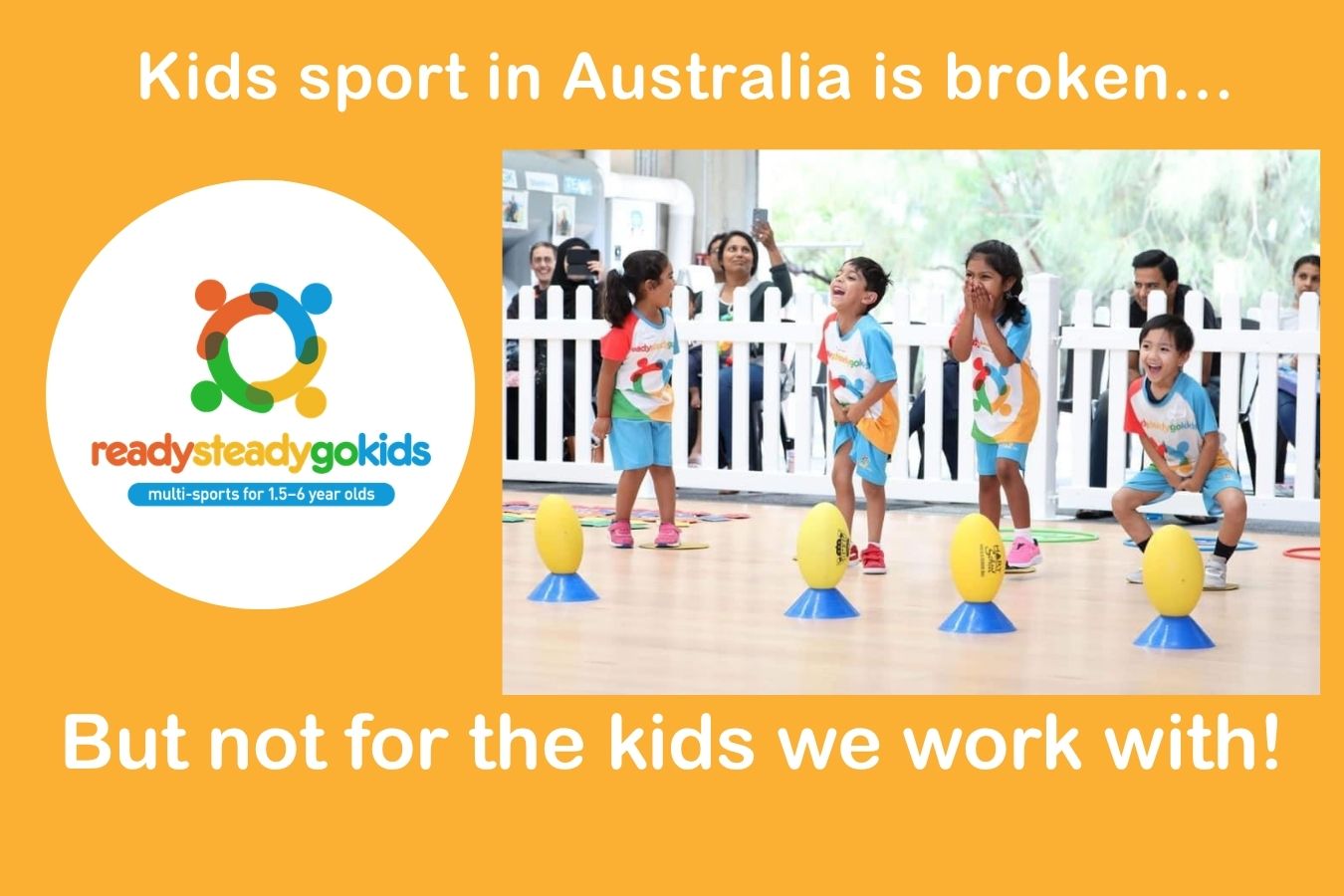
Kids sport in Australia is broken... But not for the kids we work with.
A piece published in Mamamia last week stopped a lot of parents in their tracks, and for good reason.
The article, Kids sport in Australia is broken, painted a picture many parents recognise instantly. Seven-year-olds being screamed at by coaches. Eight-year-olds doing strength and conditioning in private gyms. Swimmers training five days a week or losing their squad spot. Children dropping out of sport entirely by the time they hit their teens, not because they don't love movement, but because the joy has been squeezed out of it.
The Australian Sports Commission's AusPlay data backs this up. At age 12, around 70% of kids play sport. By 20, that figure is just 20%.
We think about this a lot at Ready Steady Go Kids. Because the children we work with are 1.5 to 6 years old and what happens in those early years matters enormously.
The window before the pressure starts
The toxic culture described in the Mamamia piece — early specialisation, win-at-all-costs coaching, parental pressure on the sidelines — all tends to take hold around primary school age and beyond.
But long before any of that, there is a critical window.
Between the ages of 1.5–6yo, children are laying the physical and emotional foundations that will shape their relationship with movement for the rest of their lives. Motor skills, coordination, body awareness, spatial reasoning, the simple confidence of knowing what your body can do — all of this is being built right now, in these early years.
This is the window we work in. And our entire philosophy is built on protecting it.
What we actually believe about kids and sport
We don't run squads. We don't grade children. We don't track personal bests or hand out pathways to elite programs.
What we do is introduce toddlers and preschoolers to the fundamentals of ten different sports: Soccer, Tennis, Basketball, Hockey, Golf, AFL, Rugby, Athletics, Cricket and T-ball. We cover the fundamental skills of these sports in a way that is age-appropriate, non-competitive and FUN.
Our program was designed by paediatric and occupational therapists. Not because we want to sound impressive, but because the science of how young children develop physically is genuinely different from how older kids or adults do. The equipment is modified, soft and age-appropriate. The coach to child ratios are low and the pace is set by the children, not by a scoreboard.
"Kids should partake in sports for the joys and fundamentals."
Matti Clements, General Manager, Australian Institute of Sport
That is, word for word, what we do every single day.
The multi-sport approach is the evidence-based approach
One of the most important points in the article is about early specialisation, and the research is unambiguous. There is no evidence that children who specialise in a single sport early perform better in the long run. What the evidence does show is that early specialisation increases the risk of burnout, drop-out, and injury.
This is why RSGK rotates through five different sports each term, changing them every term at every location. We are not trying to build the next Ash Barty. We are trying to build children who love moving their bodies, in as many ways as possible, so that when they are twelve, fourteen, eighteen, they are still playing sport!
The child who tries soccer at three, discovers they love basketball at five, and ends up playing AFL at fifteen? That child did not need a specialist coach at age four. They needed space to explore, a safe and encouraging environment, and adults who let them lead.
What parents can do right now
If you have a toddler or preschooler, the single best thing you can do for their long-term relationship with sport is to make movement joyful. Full stop.
Not structured. Not competitive. Not optimised.
Joyful.
Find a program where your child laughs more than they listen to instructions. Where trying something new feels exciting rather than risky. Where the measure of a great class is whether your child skips to the car afterwards.
"Making sure a child has a massive smile on their face while playing should be the most important thing on a parent's mind."
Ash Barty
Our coaches are trained to build confidence and curiosity — not to push, pressurise, or produce results. The results come later, naturally, when a child has a body that works well and a heart that loves being active.
A final thought
The Mamamia article ends with a simple idea: our goal as parents should be to keep kids playing as long as possible.
We think about this every time we design a class, train a coach, or welcome a new family into our community.
The child who is still playing sport at twenty, or thirty, or fifty is not the one who was pushed hardest at age seven. It is the one who was given the gift of loving it first.
That is what Ready Steady Go Kids is for.