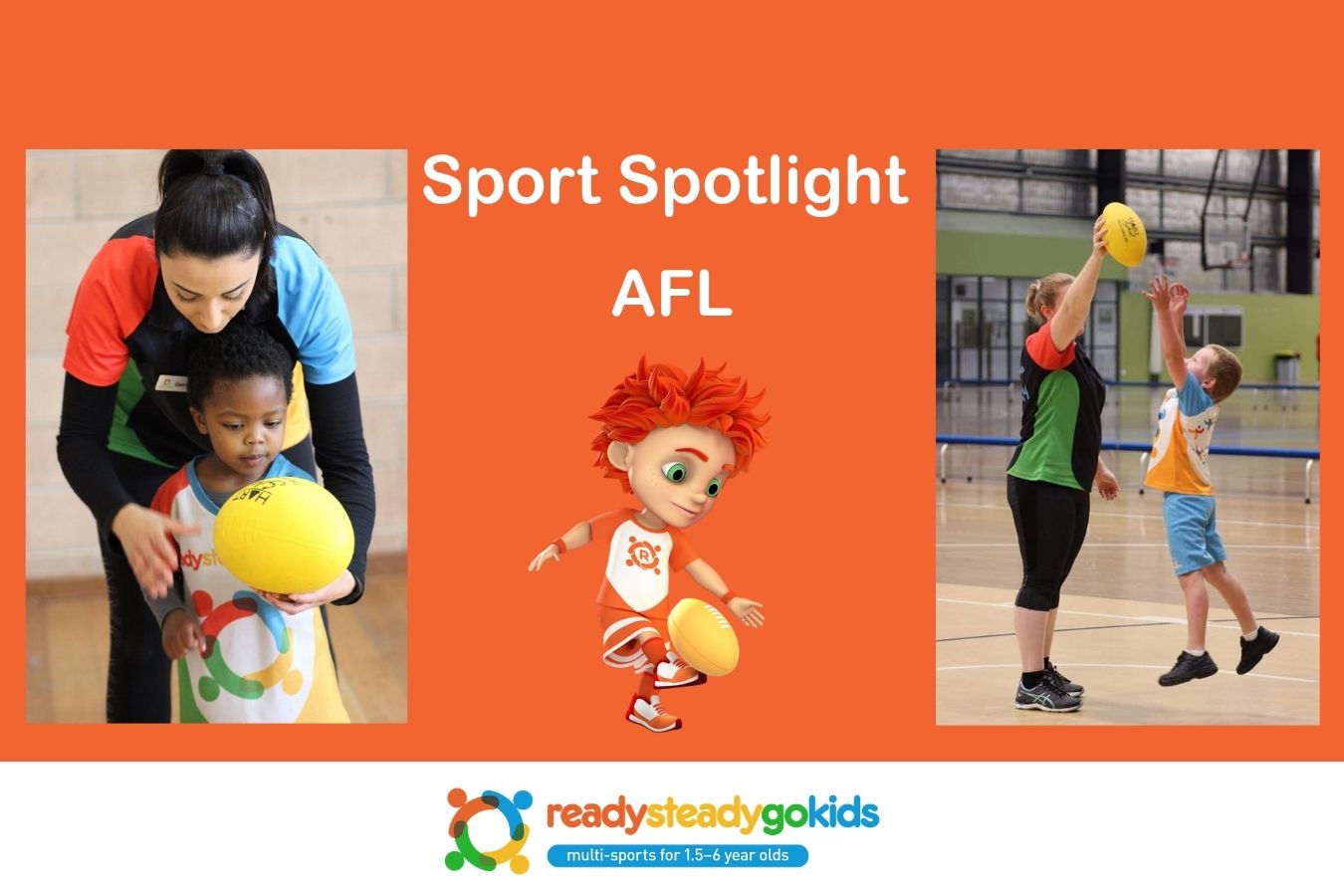
Sport Spotlight: What AFL Really Builds
By Danie O'Connor, CEO & Franchisor – Ready Steady Go Kids
There is something about a footy that instantly lifts the energy in the room. Perhaps it is the shape of the ball, the satisfying thud of a handball or the excitement of running towards a goal. Whatever the reason, AFL always brings plenty of enthusiasm to our classes.
AFL is one of the most physically varied sports in our rotation, and that variety is exactly what makes it such a valuable fortnight for development. Across our sessions, children work through handball, marking, kicking off a marker, running kicks and goal kicking, each one asking for a genuinely different combination of skills.
For young children, this is not about learning a complicated game plan or worrying about the scoreboard. It is about discovering what their bodies can do through playful, age-appropriate challenges. The skills they practise during our AFL sessions connect closely with the fundamental movement skills that support participation in sport, active play and everyday movement.
A sport full of different movement puzzles
Handball introduces a controlled punching motion that is different again to the throws children learn in other sports. Holding the ball in one hand while striking it with a closed fist builds another useful item in a child’s growing movement vocabulary. It also asks them to coordinate both sides of the body, with each hand performing a different job.
Marking, whether catching the ball overhead or at chest height, brings another layer of challenge. Children need to track a moving object in the air, judge where it is going and adjust their body position to intercept it. That is a more advanced visual tracking task than catching a ball rolled or bounced along the ground.
We build this gradually. Children might begin by catching a ball close to their body before progressing to reaching out, moving their feet and receiving the ball above their head. AFL coaching resources also emphasise watching the ball closely and positioning the hands and body for a secure catch.
Kicking off a marker and progressing into a running kick develop foot-eye coordination in a way that is genuinely different from the kicking style used in soccer. AFL uses a drop punt technique, which requires precise timing between the drop of the ball and the swing of the leg. Children are learning to control the ball, their balance and the direction of their kick all at once.
Why timing matters so much
That timing element is really the heart of what AFL builds. Coordinating the drop of an object in one part of the body with a controlled strike from another part is a sophisticated motor planning task. It is exactly why we introduce this progressively, starting with a stationary kick off a marker before building up to the full running kick as children move through the Ready, Steady and Go groups.
We love watching the moment when a child realises that the kick was not just luck. They dropped the ball, timed the swing and made contact because their body was beginning to understand the sequence. It might not look perfect every time, and it certainly does not need to be, but each attempt gives them information to use next time.
Carmen Dodds, our in-house occupational therapist, often highlights marking as a standout skill in this sport. She explains that overhead catching, judging a ball’s trajectory and positioning the body to receive it are among the more advanced visual perceptual skills we ask of young children across the program. These abilities transfer well beyond the sports court into everyday coordination and body awareness.
Carmen also describes marking as an underrated developmental skill. Catching something coming towards you through the air, rather than rolling or bouncing along the ground, is a real step up in visual tracking and body positioning. It is wonderful to see children build that confidence over a fortnight of practice, particularly when they begin to move from “I can’t catch it” to “throw it again!”
Skills build in complexity as children progress from Get Ready through to the Go group, from simple footy marks and kicks off a marker to full handball, drop kicks and goal kicking technique.
GROSS MOTOR SKILLS
- Kicking off a marker, building to running kicks, drop kicks and goal kicking
- Marking (catching) the ball with outstretched arms, drawing it into the chest
- Carrying and running with the ball as a team
These activities involve the large muscles of the legs, arms, trunk and whole body. Children practise balancing on one leg, moving with control, changing direction and coordinating their bodies while carrying an object. For parents, this can look like a lively game of footy; underneath it, children are developing the movement confidence they need for running, climbing, jumping and active play.
FINE MOTOR SKILLS
- Handballing: striking the ball off a balanced hand with a closed fist
- Placing the ball precisely onto a coloured target or marker
AFL is not only about big kicks and energetic runs. Handballing requires controlled hand movements, while placing the ball on a target asks children to use precision and visual attention. These smaller movements support the control needed for everyday tasks such as manipulating toys, using cutlery and managing clothing fasteners.
KEY DEVELOPMENT AREAS
- Foot-Eye Coordination: guides accurate kicking and goal kicking
- Hand-Eye Coordination: guides the fist to strike the ball in a handball
- Bilateral Integration: one hand balances the ball while the other strikes it in a handball
- Body Awareness: knowing where the body is, without looking
A child’s brain is constantly working out where the body is in relation to the ball, the target and the other people in the activity. These skills support motor planning and spatial awareness, helping children make decisions about how much force to use, where to step and when to move. The result is not just better ball control, but greater confidence in navigating the physical world.
GETTING READY FOR SCHOOL
- Balancing to kick builds the core stability needed for sitting posture
- Colour based instructions build vocabulary and working memory
- Relay sequences build patience and self regulation
School readiness is much broader than knowing letters and numbers. In AFL activities, children listen for instructions, remember sequences, wait for their turn and respond to changing cues. They are also practising how to have a go when something feels tricky, a valuable foundation for curiosity, adaptability and problem-solving in the classroom.
LIFE SKILLS
- Handballing builds the fine motor and bilateral control used doing up press studs and buttons on clothing
- Marking the ball by hugging it into the chest is the same motion used carrying a bowl to the table
- Kicking with control supports the leg coordination used taking socks off and putting them back on
The best early learning often hides inside ordinary play. Children do not need to know that they are rehearsing the skills involved in dressing, carrying objects safely or coordinating both sides of their body. They simply know they are having fun, moving around and celebrating a successful mark with their friends.
From the drop punt to the overhead mark, AFL packs a surprising amount of coordination and timing practice into two very fun, very energetic weeks.