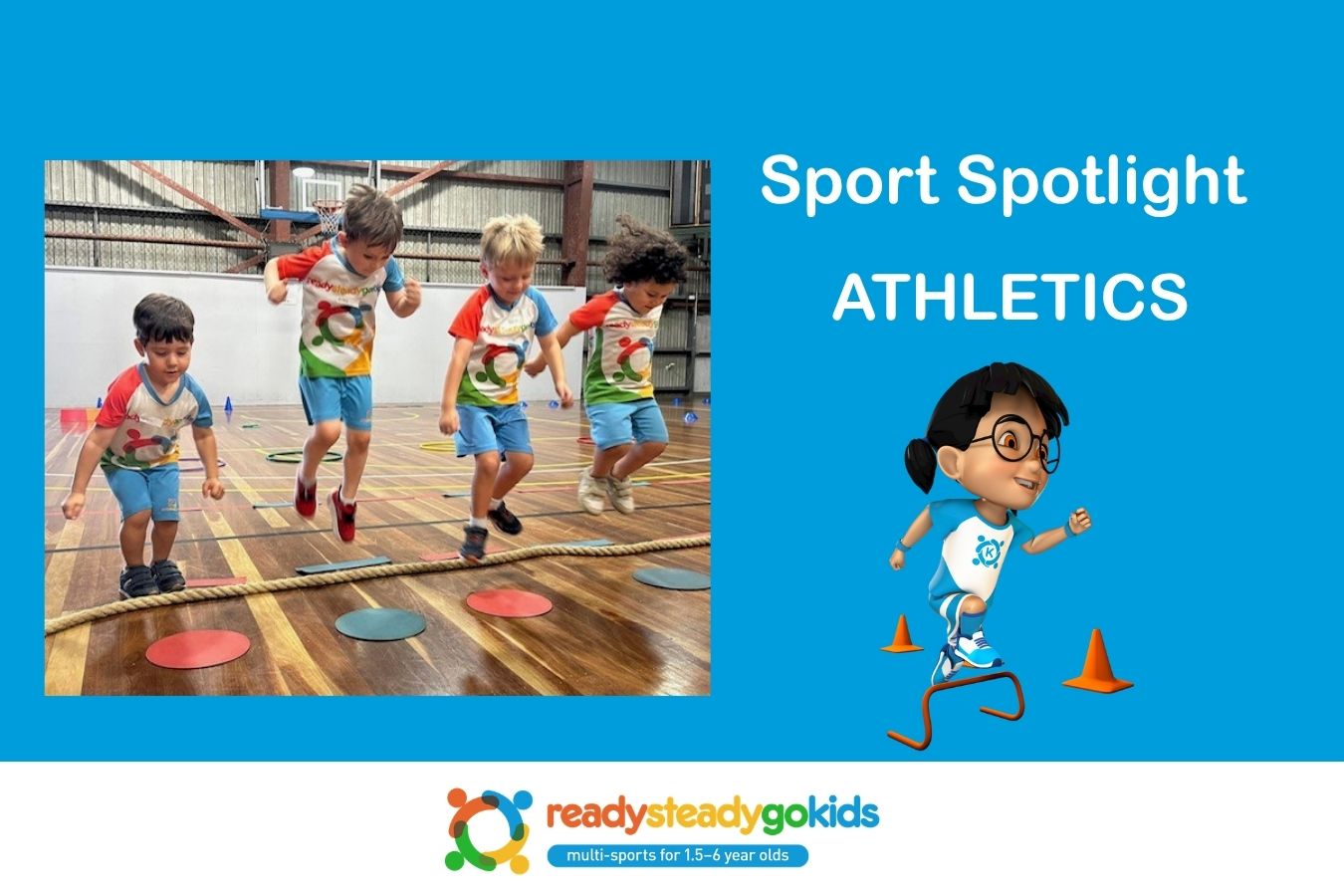
Sport Spotlight: What Athletics Really Builds
By Danie O'Connor, CEO & Franchisor - Ready Steady Go Kids
Athletics is a bit different from the other nine sports in our rotation because it is not really one skill. It is several skills stitched together into a single high-energy session. Hurdles, shotput, long jump, sprinting and relays all show up across the fortnight, with javelin, appearing in our older age group classes, which makes athletics one of the most varied and physically demanding blocks on our calendar, in the very best way.
There is something wonderfully entertaining about watching a group of young children take on athletics. Each event asks something slightly different of a young body. Hurdles demand that a child judge distance and timing well enough to clear a low obstacle without breaking stride, which is an early and genuinely impressive feat of motor planning. Long jump asks a child to combine a short run-up with a controlled, two-footed take-off and landing, coordinating speed and balance at the same time, and in our older age group classes it progresses into triple jump.
Shotput, using a soft beanbag, introduces a push-like throw rather than a rotational throw, that is quite different from the overarm and underarm throws children practise in other sports. In the older age group classes, javelin, thrown with a foam rocket, introduces an overarm throwing action with a run-up, building on the throwing patterns children already know and adding a genuine sense of power and distance. Sprinting brings pure locomotor speed, while relays add the challenge of a handover: timing a run to meet a teammate and passing an object without dropping it or stopping.
What ties it all together developmentally is spatial judgement and whole-body coordination under a little bit of time pressure. Athletics does not give a child long to think before they move, which is exactly why it is such a valuable addition to a well-rounded program. Children learn to notice, decide, move and adjust.
Research into fundamental movement skills describes running, jumping, hopping, throwing and balancing as important building blocks for later participation in games, sport and physical activity. You can read more through NSW Health’s fundamental movement skills resources. At RSGK, we introduce these skills in playful, age-appropriate ways, without expecting a toddler to perform like a miniature Olympian.
Carmen Dodds, our in-house occupational therapist, often highlights the relay component because it introduces a social and cooperative element that most individual events do not. Passing a baton successfully requires a child to time their movement to another child’s movement, which is a genuinely advanced coordination task layered on top of an already active session. Carmen describes the relay as one of the few times young children coordinate their movement directly with a teammate’s timing, not just their own body. For a three or four-year-old, that is a sophisticated skill and valuable groundwork for cooperative sport later on.
Skills build in complexity as children progress from Get Ready through to the Go group, from basic throws and jumps to full sprint starts, hurdles and relay technique.
GROSS MOTOR SKILLS
- Throwing, jumping and running with control
- Whole body coordination through an obstacle circuit
- Hopping and single leg balance, progressing to the triple jump
These are the big movements that help children feel capable in their bodies. An obstacle circuit might involve stepping, running, jumping and weaving, requiring children to move with purpose while responding to what comes next. Hopping and balancing can be challenging, particularly when a child is still working out where their feet belong, so we celebrate the attempt as much as the finished movement.
FINE MOTOR SKILLS
- Placing beanbags precisely onto targets
- Precise hand and finger placement in the sprint start position
Athletics may look like a big-body sport, but little hands are working hard too. Placing a beanbag accurately requires fingertip control, visual judgement and a steady release. In the sprint start position, children learn where to place their hands and how to prepare their fingers and palms to support the next movement.
KEY DEVELOPMENT AREAS
- Hand-Eye Coordination: guides accurate throwing towards a target
- Body Awareness: knowing where the body is, without looking
- Bilateral coordination: hands work together to receive, hold and pass the baton
- Motor Planning: plan and execute new movements
These skills are constantly working together. A child may need to look at a target, remember the instruction, position their body, hold a beanbag and decide when to throw. That is a lot of information for a young brain to manage, which is why repetition and encouragement matter. It is also why our coaches focus on creating a positive environment rather than rushing children through activities.
GETTING READY FOR SCHOOL
- Throwing and jumping technique builds the visual motor planning used in early writing
- Multi step circuits build memory and instruction following
- Songs and instructions build vocabulary and listening
Athletics supports school readiness without turning play into a worksheet. Children listen for instructions, remember a sequence and respond to words such as “behind”, “over”, “under”, “next” and “stop”. Meanwhile, parents often find themselves chatting with other mums and dads while watching the circuit unfold. Those small sideline conversations can become familiar faces, shared coffees and the beginnings of a useful local support network.
LIFE SKILLS
- The sprint start crouch (hands down, ready to push off) mirrors bending down to put on shoes or socks
- Hopping on one leg develops the balance needed to dress, such as pulling pants up or down one leg at a time.
- The overhand throwing action develops the arm strength needed to pull a jumper over the head.
This is the everyday magic of physical literacy. A child is not thinking, “I am practising the movement needed to get dressed.” They are simply having fun taking part. But the strength, balance, coordination and body awareness they build can make ordinary tasks feel more manageable over time.
Athletics might be the busiest fortnight on the calendar, but that variety is exactly the point, giving children a broad, transferable base of movement skills all in one energetic block. It is a chance to run, jump, throw, balance, cooperate and have a very good time doing it.