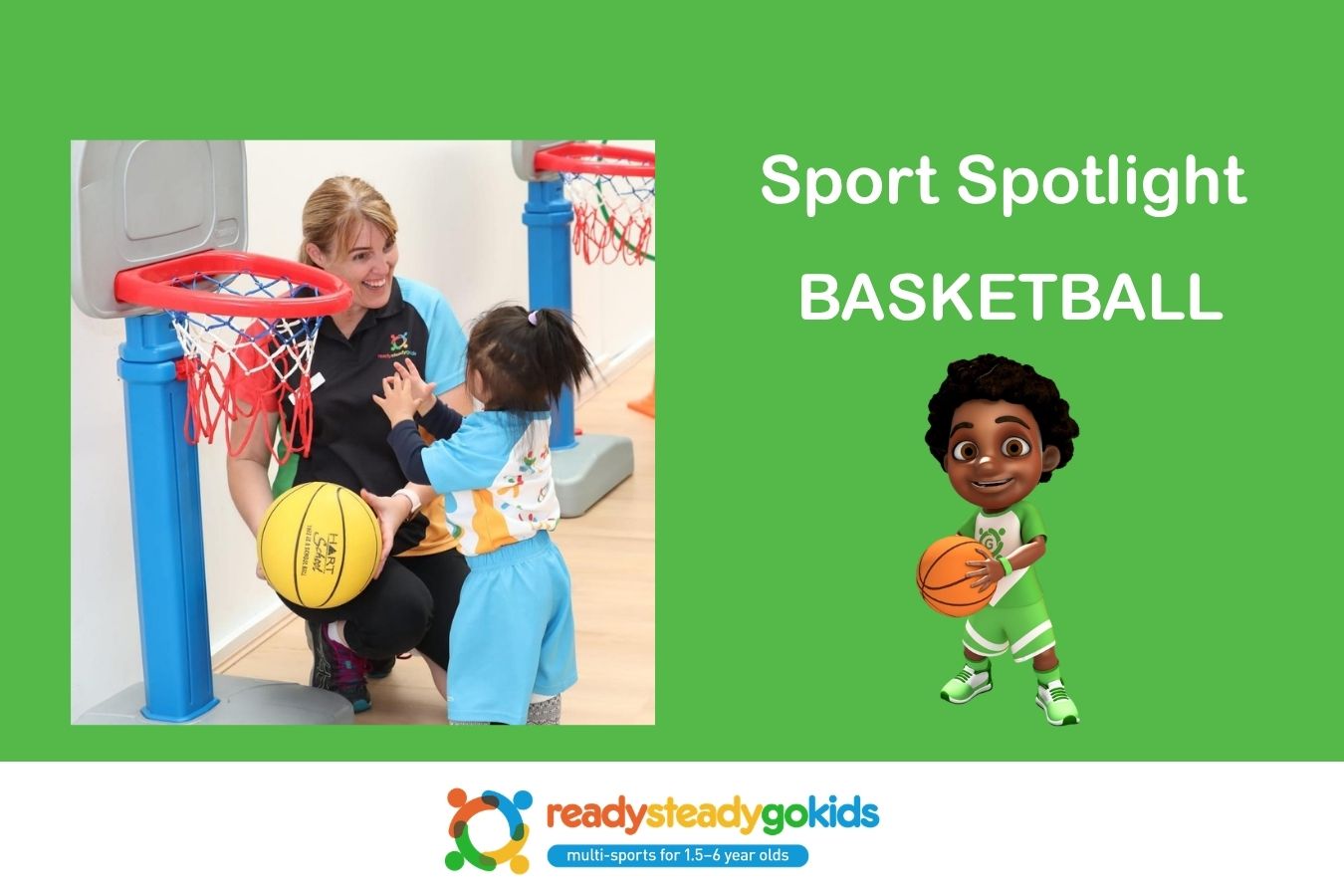
Sport Spotlight: What Basketball Really Builds
By Danie O'Connor, CEO & Franchisor - Ready Steady Go Kids
Basketball is one of the first sports of the term. Most parents picture their toddler attempting an ambitious shot at a hoop that towers over them. What is actually happening underneath that shot is a lot more interesting.
Before any child in our class shoots a goal, they start with something much simpler: ball familiarisation. They get comfortable holding, rolling and feeling the size and weight of a basketball in small hands. From there, we move into the chest pass, then catching, then the drop and catch, before goals come in as the final piece. Each step is a deliberate build, not a random sequence of drills.
Passing and catching a ball that is roughly the size of a child’s own head demands genuine hand-eye coordination. The two-handed nature of a chest pass also builds bilateral coordination: the ability to use both sides of the body together in a controlled way. That same skill later supports everyday tasks such as using scissors, buttoning a shirt or steadying paper while writing with the other hand.
This is part of what makes basketball such a valuable inclusion in our sports program. It may look like a game of shooting hoops, but children are also practising object control, timing and body awareness.
Basketball also asks a lot of a child’s spatial judgement. Working out how hard to push a ball so it reaches a hoop, tracking where a bouncing ball is going to land and judging the right moment to catch all require children to notice, predict and respond. Over time, these visual tracking and timing skills support everyday movement, from catching a thrown object to judging the space between themselves and a friend on the playground.
Carmen Dodds, our in-house occupational therapist, often points out that basketball is one of the clearest examples of how a “big” sport hides a lot of “small” skill building. She notes that the repeated catch-and-release pattern helps develop grasp and release control, which later appears in skills such as holding a pencil and releasing an object with intention rather than simply dropping it. She also highlights how naturally a two-handed chest pass encourages both sides of a young child’s brain and body to work together towards one goal.
I love watching that progress unfold in classes. One week, a child may need help positioning their hands. A few sessions later, they are catching with more confidence, adjusting their force and proudly having another go after a missed shot. There is no pressure to be perfect. The goal is to make movement feel enjoyable, achievable and worth repeating.
Skills build in complexity as children progress from Get Ready through to the Go group, from simple ball rolls and toddler basketball to full chest pass, dribbling and shooting technique.
That progression matters because it gives children the chance to feel successful at each stage before the next challenge is added. In Get Ready, the focus is often on confidence with the ball itself: holding it, rolling it, stopping it and beginning to understand how their hands and eyes can work together. As children move into Ready and then Go, we can layer in more technique, more timing and more control.
Carmen often speaks about this as one of the strongest links between physical literacy and confidence. When children feel capable in their bodies, they are more willing to join in, have another go and feel like they belong in the group rather than standing back and watching.
Gross Motor Skills
- Passing, throwing and catching with control
- Ball handling, dribbling and shooting towards a hoop
- Whole body coordination through an obstacle course
These bigger movement patterns are often the first things parents notice on the courts. A child who once chased after every loose ball starts passing with purpose. A bounce that looked accidental begins to look controlled. A shot that was all excitement and no direction starts to show real aim. Basketball gives children repeated opportunities to build these gross motor patterns in a fun setting, which is exactly why it works so well in our program.
Fine Motor Skills
- Fingertip control to grip, bounce and catch the ball
- Finger and wrist control help guide and release the ball towards the hoop when shooting for a goal.
This is the part that can surprise people. Basketball looks like a big-body sport, but it also asks for small, precise adjustments through the fingers, hands and wrists. Carmen regularly highlights that these grasp-and-release movements are not separate from day-to-day development. They are part of the same picture. The child learning to control a bounce is also building the kind of hand control that supports later classroom tasks and more confident independence at home.
Key Development Areas
- Hand-Eye Coordination: guides hands to a hoop or team mate
- Bilateral Integration: both hands working together to pass and dribble
- Midline crossing: twisting or reaching across the body to pass, catch or move the ball behind the back and overhead.
- Body Awareness: knowing where the body is, without looking
These foundations sit underneath the visible basketball skills. Hand-eye coordination helps children judge distance and direction. Bilateral integration supports movements where both sides of the body need to work together smoothly. Midline crossing comes into play when children twist, reach or transfer the ball across their body, which is a surprisingly important skill for coordinated movement. Body awareness helps children realise where they are in space, where the ball is and what their body needs to do next. Together, these areas support not just sport but smoother, more confident everyday movement.
Getting Ready for School
- Hand eye coordination lays the foundation for handwriting
- Counting reps, colours and numbered targets build early numeracy
- Following instructions builds vocabulary and listening
For parents of toddlers and preschoolers, this is often where the penny drops. Sport does not sit in a separate box from learning. In classes, children are listening, watching, remembering and responding all at once. They may be counting how many passes they can do, following a coach’s directions through a basketball obstacle course or aiming for a coloured target. These experiences build attention, comprehension and early problem-solving in a way that feels playful rather than pressured. On those long parenting days when everyone is a bit tired and snacks have somehow become a full-time job, it helps to know that active play can support school readiness without needing to feel like homework.
Life Skills
- Catching with two hands builds the control used to hold a cup steady while drinking
- Bouncing and catching the ball supports the timing used pouring water from a small jug
- Weaving through the obstacle course builds the coordination used carrying a plate to help set the table
This is one of my favourite things about watching basketball in classes. The benefits do not stay neatly on the courts. They show up in ordinary family moments. The control needed to catch with two hands links to everyday steadiness. The timing needed to bounce and catch supports more coordinated movements during self-care and helping at home. The body control used to weave around markers carries over into all sorts of practical tasks. Parents often notice these changes gradually, then all at once. One day their child suddenly manages something a little more independently, and it is a lovely reminder that movement skills and life skills are often building side by side.
Next time basketball rolls around on the sport rotation, know that every pass and catch is doing double duty, building a love of the game and a genuine physical skill set at the very same time.