Sport Spotlight: What Golf Really Builds
By Danie O'Connor, CEO & Franchisor - Ready Steady Go Kids
Golf is one of the trickiest sports we teach, which is exactly why it always sits in the middle of the term rather than at the start or end. By the time golf rolls around, children are settled into the rhythm of class and ready for a sport that asks for something most of our other sports do not demand quite as much: patience and precision over power.
That can be a big ask for a young child. Many of our children arrive ready to run, jump, kick and throw with the enthusiasm of someone who has just discovered a bottomless supply of energy. Asking them to slow down, stand still and aim at a small target is a genuine challenge, but it may just require encouragement, excellent timing and a small miracle.
How we teach golf in classes
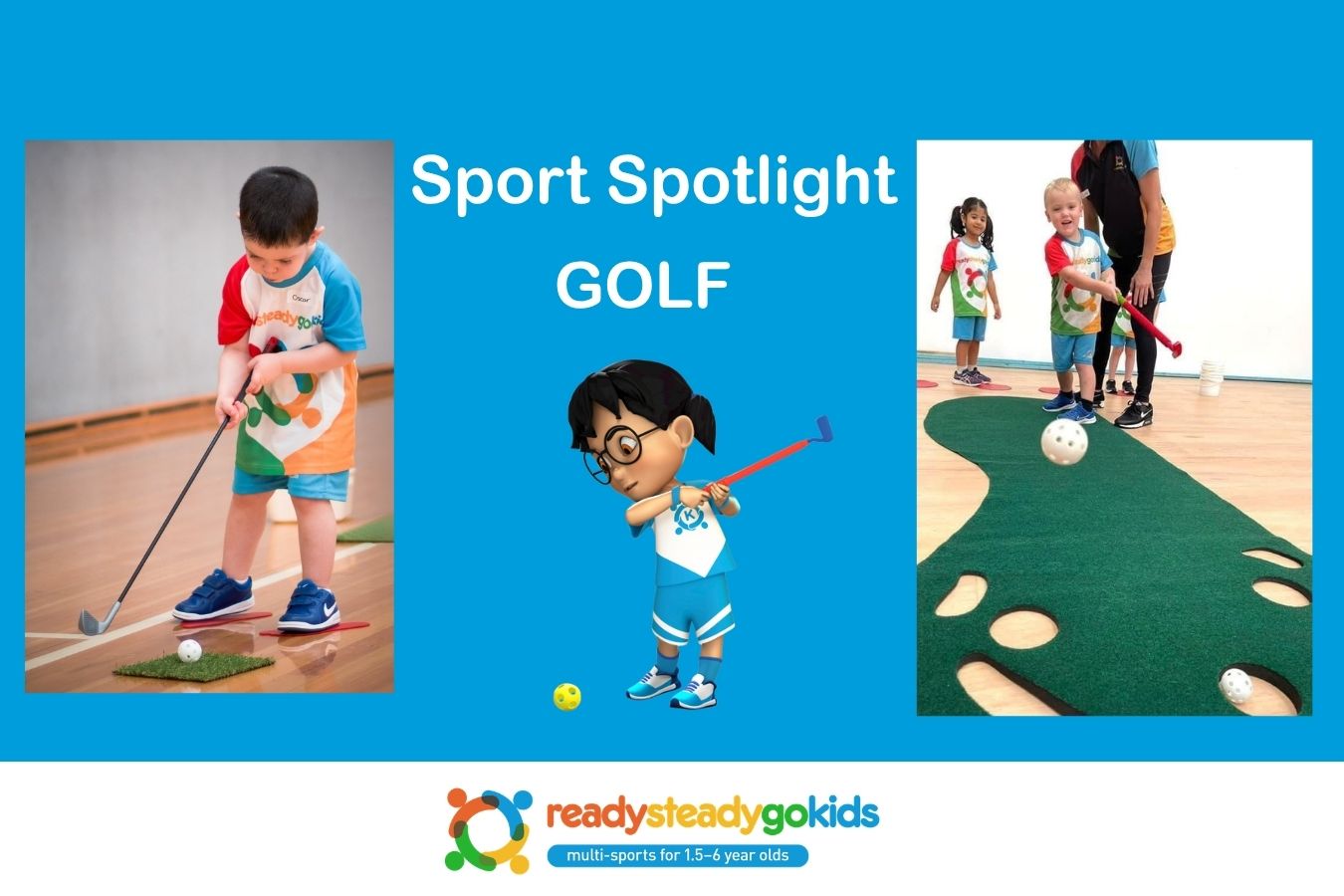
Our golf sessions centre almost entirely around putting. We begin with simple putting practice, move into putting at a target, and then progress to putting on a dedicated golf surface for the more advanced groups.
Unlike sports that reward a big, energetic swing, putting rewards control. A child has to line their body and club up carefully, judge the right amount of force, and follow through smoothly rather than simply swinging as hard as they can. It is a genuinely different physical and mental skill from the running kicks and big throws found elsewhere in our rotation.
The activities are playful and age-appropriate, with children exploring how far a ball will travel, what happens when they use too much or too little force, and how their body position affects the direction of the ball. There is no expectation that a preschooler will suddenly develop a professional golfer’s technique. We are building confidence, coordination and curiosity one small putt at a time.
The skills hiding in a quiet putt
Golf is one of the best sports in our program for building fine motor precision and self-regulation together. A child has to settle, fix on a small target and control an implement with real intention. That creates a wonderful contrast to the higher-energy sports and gives even our most enthusiastic movers a chance to practise stillness and focus in a fun, low-pressure way.
What we notice most is the concentration. Children who may usually be racing around the court suddenly become very serious about the position of one small ball. They look at the target, adjust their feet, grip the club and think carefully about what they want to do next. Of course, there are still plenty of excited celebrations, dramatic misses and balls that travel in a direction nobody expected. That is part of learning too.
Carmen Dodds, our in-house occupational therapist, often points out that golf is one of the few sports in our program that closely mirrors the controlled, deliberate hand movements children will later need for handwriting. Gripping a club correctly, controlling the swing path and following through with intention all draw on similar motor pathways to holding and guiding a pencil. As Carmen explains, the grip, stance and slow deliberate swing are genuinely closer to a pre-writing activity than many people realise, wrapped up in a fun sporting context.
Skills build in complexity as children progress from Get Ready through to the Go group, from simple putting and ball placement to a full swing with backswing, follow-through and body rotation.
GROSS MOTOR SKILLS
- Backswing, downswing and follow-through in a full golf swing
- Eye hand coordination aiming a club at a ball
- Whole body coordination and rhythm through group games
Golf may look small and controlled, but it still involves the whole body. Children learn to stand with balance, coordinate their arms and shoulders, and move through a swing with rhythm. Group games also encourage children to walk, turn, reach and respond to instructions while staying aware of the space around them.
FINE MOTOR SKILLS
- Placing golf balls into witches hats (Get Ready classes)
- Placing balls into muffin tray holes (Get Ready classes)
These activities are wonderfully practical for little hands. Picking up, positioning and releasing golf balls helps children practise finger strength, dexterity and precision. As the Cleveland Clinic explains, fine motor skills support everyday tasks such as drawing, dressing, eating and using tools. In our classes, those important movements are developed through play rather than worksheets.
KEY DEVELOPMENT AREAS
- Bilateral Integration: both hands working together to hold the club
- Hand-Eye Coordination: guides the club towards the ball and target
- Body Awareness: knowing where the body is, without looking
- Crossing the Midline: the swing's follow-through requires the body to rotate and reach across the midline
These development areas help children make sense of how their bodies work. Using both hands together, tracking a ball and rotating through a swing all require children to organise movement from their feet to their fingers. With patient coaching, they begin to understand that a small change in their stance or grip can change what happens next.
GETTING READY FOR SCHOOL
- Fine motor precision builds the pincer grip needed for pencil control
- Aiming builds the visual motor planning used in early writing
- Colour concepts and instructions build vocabulary and listening
Golf gives children a gentle opportunity to listen, remember instructions and act on what they have heard. They may be asked to find a particular colour, place a ball in a certain position or aim towards a specific target. These simple activities build the attention, language and visual planning that support a confident start to school.
LIFE SKILLS
- In Get Ready classes: Placing golf balls precisely into the muffin tray holes develops finger strength & precision needed to do up buttons for dressing
- The 2 handed grip on golf club is the same bilateral control needed to hold and use a fork to spear food.
- Waiting for a turn in the group develops patience, the same skill needed when waiting to wash their hands at a shared sink.
The life skills are often found in the little moments. A child waits, watches, tries, adjusts and tries again. They learn that they do not always need to rush, and that taking care with a task can help them achieve their goal. Those are useful lessons for getting dressed, eating independently, joining a group and coping when something does not work the first time.
Golf might be the quieter fortnight on the calendar, but the quiet control it asks of children carries into far more than just the putting green.