Why Multi-Sport Kids Come Out Ahead
By Danie O'Connor, CEO & Franchisor - Ready Steady Go Kids
Everyone seems to be talking about sport specialisation this week, and I LOVE IT!
Libby Trickett’s Sportish conversations have made the topic refreshingly easy to follow: clear, evidence-informed and relevant to real families. The Australian Sports Commission’s position statement reinforces something we’ve believed at Ready Steady Go Kids since 2004: little ones benefit from trying a variety of sports before anyone asks them to choose just one.
What the Australian Sports Commission is saying
The Australian Sports Commission’s guidance encourages families, coaches and sporting clubs to think carefully about early specialisation. Intensive, year-round focus on one sport before age twelve has been linked with burnout, injury, reduced motivation and psychological stress. Kids who stay broad through their early years and specialise later are more likely to genuinely succeed in the sport they eventually choose.
Matti Clements, director of the Australian Institute of Sport, put it perfectly: 'What we don't want is kids specialising really early and losing their love for it and not partaking in sport at all in the future. That's the worst thing we could hope for.' She also had a gentle dig at the academies that push early specialisation with a compelling message built on misinformation. The numbers back it up: soccer, Australia's most played junior sport, peaks between nine and eleven, then drops off a cliff. Netball, cricket, AFL, basketball, tennis and rugby league all show the same pattern. Kids are not falling out of love with sport for no reason; they are being steered into one sport, one skill set, far too early.
That matters when junior sport participation often peaks around ages nine to eleven, then takes a nosedive. If children lose the fun early, it is worth asking whether we have rushed them towards performance before they have even had a chance to enjoy moving.
A broad start can be a good head start
Roger Federer tried a small mountain of sports before choosing tennis: skateboarding, basketball, table tennis, badminton, football, wrestling, skiing and swimming. He has said plainly that focusing on one sport too soon leads to burnout. Closer to home, Australian cricketer Kim Garth played football in winter, cricket in summer and a healthy dose of Gaelic football growing up: 'I couldn't speak more highly of trying to play as many sports as you can when you're younger.' Neither of them lost time by keeping things broad. If anything, they got a head start. For most families, the early years are a time to explore, not sign a lifelong sporting commitment.
More than organised sport
In the Words Grow Minds episode “Why kids need more huff and puff”, Professor Hayley Christian from The Kids Research Institute Australia makes the case that children need genuine energetic play, real huff and puff, built into every single day. She leads the Play Active program, developed over ten years of research and designed specifically for early learning services. Its guidance is refreshingly blunt: young children should get around 3 hours of daily physical activity, including at least 60 minutes of genuine energetic play, and most are falling short. Not because they are inactive, but because the activity is not vigorous enough to count as real huff and puff. This is exactly the gap a program built on variety helps close: ten different sports across the year give a child far more chances across the week to hit that mark in a way one sport, practised the same way every session, simply cannot.
Ten sports, lots of ways to move
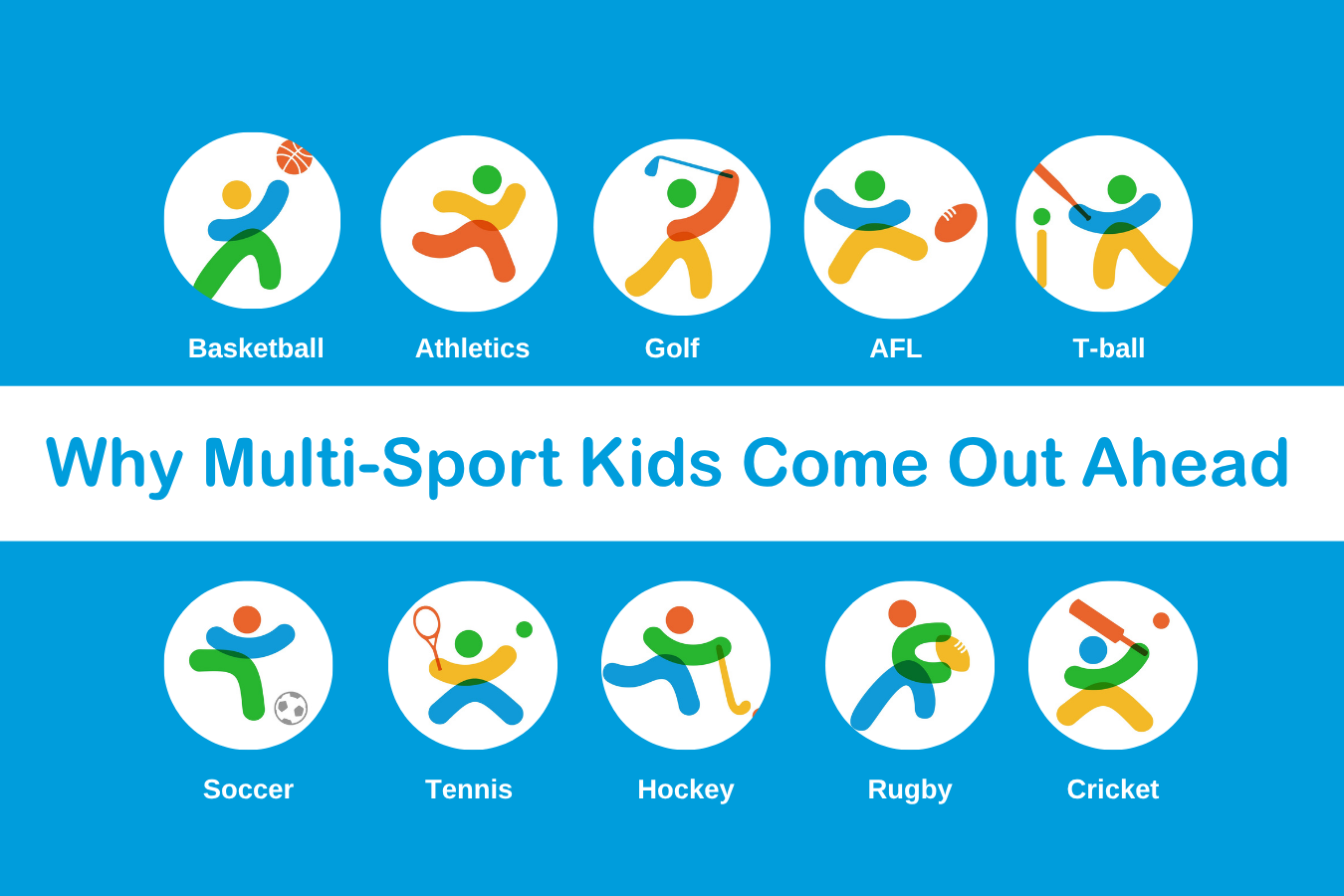
At Ready Steady Go Kids, our physio-designed program gives children aged 1.5 to 6 years a chance to explore soccer, basketball, tennis, athletics, T-ball, hockey, golf, cricket, AFL and rugby across two terms. It is not just for variety's sake, although the kids certainly never get bored. Those ten sports, stacked together, add up to a genuinely whole-of-body gross motor workout no single sport could deliver on its own.
Soccer and basketball cover foot-eye and hand-eye coordination, bilateral movement and jumping power. Tennis and athletics build cross-lateral coordination, reaction time and the fundamental running, jumping and throwing patterns everything else is built on. Golf and hockey add precision, core rotation and a different kind of hand-eye challenge: tracking something that slides along the ground rather than flies through the air. AFL and rugby bring agility, spatial awareness and total body strength. T-ball and cricket round it out with grip strength, throwing power and the kind of sustained focus a game with a bit more pace and patience requires. By the end of 2 terms, a child has quietly built strength, coordination and confidence through their whole body, not just the one muscle group a single sport happens to favour.
And it does not stop there. Once all 10 sports have been covered, our progressive program brings each sport back around for another fortnight, a little harder and a little more skilled than the first time. Children get to meet an old favourite again and again, each time more challenged and more capable, term after term, right through to school age.
Our in-house occupational therapist, Carmen Dodds, reminds us that physical literacy is about more than learning movement skills: it helps children feel capable enough to join in. When children get to try different activities at their own pace, they can find ways to participate, connect with others and feel they belong. That confidence can help nurture a lifelong enjoyment of movement.
“For the past 15 years, I’ve watched thousands of small, excitable humans discover what their bodies can do. Seeing them grow into confident, well-rounded movers is a joy, and a lovely reminder that sport should begin with fun.”
What this looks like for parents
- Choose activities that build a range of movement skills, not just one technique.
- Let your child sample different sports across the year.
- Look for giggles and enthusiasm, not a perfectly straight kick.
- Leave serious specialisation until well beyond the early years.
- Think of early sport as a warm-up for life, not the main event.
You can explore our sports and program benefits to see how variety supports children’s development.
This is not a sales pitch dressed up as science. It is simply what we have seen, week after week, in classes full of wobbly, wonderful little movers, and the Australian Sports Commission's position statement confirms it on the record. Let's keep the conversation rolling on podcasts like Sportish, and in every club, sports program and academy across the country making decisions for little humans right now.
Sources: Australian Sports Commission position statement; ABC News, 27 October 2026; Words Grow Minds podcast, “Why kids need more huff and puff”; Play Active, The Kids Research Institute Australia; Sportish on Instagram.
So here is to the multi-sport kids: the ones who try everything, giggle through warm-ups and kick in roughly the direction of the ball. The evidence says they come out ahead. We have known it all along, and it is lovely to see the rest of the sporting world catch up.